
Hello, dearest readers. I purchased some wool for weaving yardage recently and wanted to try to squeeze out as much fabric as I could from the cones of fiber that I had. Weaving yarns of good quality are an investment and the idea of pitching 28″ of loom waste from each warp end in my project was something that I was reluctant to do.
I’ve tied on new warps to old ones many times, but I hadn’t put on a “dummy warp.” A dummy warp will not be woven, it is like a template for a subsequent warp. I used 8/4 cotton carpet warp for my dummy warp. I had a cone of very non-colorfast (very annoying) green that I used since it was going to be unusable for anything else and another cone of a minty green carpet warp that I purchased many year ago and never used. I used materials I had on hand. (I had considered pitching the darker green carpet warp after my first weaving mishap with it, but I was glad to have kept it for this purpose). Some quick calculations told me that my dummy warp of 248 ends took about $6.84 of fiber based on its current price of $10.95 for a put up of 8 oz. Here is the warp, which I wound in a double length to save some time:

I sleyed the reed at 1 end per dent in a 10 dent reed. It didn’t take too long to warp the loom; the draft was for a straight twill.

After I beamed the dummy warp, I tied on the wool warp ends. I used Harrisville Designs “Shetland” in “Hyacinth.” My warp for the wool was 3.75 yards long.
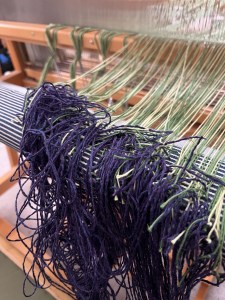
Jiggling the knots through the reed and the heddles wasn’t too difficult since the sett was 10 ends per inch and there seemed to be plenty of room to ease the knots through the spaces required. Whew!
Here’s a look at the wool fabric on the loom:

Weaving the yardage was a bit dull as it was a straight twill, but hey, a little meditative weaving is nice every so often. I got to the end of the warp quite quickly as the weave was balanced (10 picks per inch). Now it was time to assess what remained on the loom.

I had about 10.5″ of warp that could not be woven and an additional 8″ of warp that was lost to the front beam:
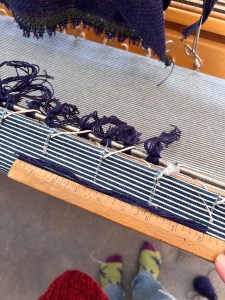
My usual warp waste amounts on the LeClerc Nilus 2 are closer to 28 inches per end, so I reckoned that I saved about 10 inches of wool warp by using the dummy warp. Since I had 248 ends in my warp, I calculated that I saved over 68 yards of wool by tying onto the dummy warp, which is not a huge amount, but I was happy about having an additional 1/4 yard length of finished woven fabric to use. Yay!
So, was this worth it? From a dollars and cents point of view, probably not. I saved about $2.02 worth of wool by tying on the wool warp to the carpet warp. Also, I did not keep track of how much time it took to prepare the “dummy warp” and tie on the new, wool warp. Was I happy to use up part of a cone of 8/4 cotton carpet warp that was otherwise unusable? Yes! This was a definite bonus. A dummy warp could be one way to use cones that may otherwise languish in a stash.
And here is another thing I thought of whilst working at the loom : a dummy warp could be wound in a light color (or colors) that is a little easier to see. Over the last couple of years I have had increasing difficulty seeing black and other dark colors that I selected for a warp. If I decide to work a project that requires a dark colored warp, I will definitely consider the dummy warp approach.
This must have been a very thrilling read. (Ha!) But I hope it was useful. I doubt that I will employ the dummy warp method for every project, but for a high value fiber project, it may very well be worthwhile to consider. If you’ve had a different experience with a dummy warp, please share in the comments section!
Stay tuned to see what is crafted from the “Hyacinth” wool twill.
Happy weaving,
Kate K.

 Kate Kilgus